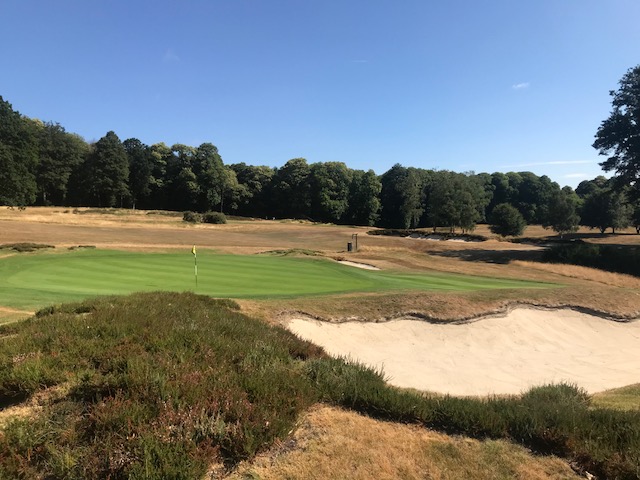
Monday, 27 August 2018

Beware ‘The slow recovery‘


Hi All,

Just thought I would do an update on what will happens now the rain has started to come down again and boy has is come down.  

It is now true that this last heat wave gave 1976 a run for is its money. I haven’t ever seen a summer like this that’s for sure.


The closest I can remember was the heat wave of 1995 and that was the year I carried out my “work experience” as a Greenkeeper... little did I know it would shape my entire life from that point. 

It’s definitely been a struggle, a struggle to keep greens alive let alone playing areas with no water. Unfortunately those areas gave in weeks ago. These areas fairways, semi rough, roughs and surrounds (where the water doesn’t reach) are now in limbo, not completely dead but not alive either.


The recent rain has given us some colour and the Fescue and Rye grasses have come back to life slowly and especially in the hollows on the likes of the 1st, bottom of 6th, 12 and 14th. The colour isn’t all green is a brownie/ black and green.


The brownie colour  is the the areas that haven’t quite fully died out. These are mainly the Fescues, typical
of links turf these lose colour but hold on to their lead during drought conditions. They are fantastic to play from. 

The green tends to be patch’s of Rye that are more clumpy looking again can be great to play from if even coverage is achieved like our tees but not so much when mixed with the fescues.

Drought damage leaving dead bare areas

The black area areas that have completely died off and these areas can become particularly slippery during wet conditions so please be aware. These tend to be annual meadow grass as it’s a shallow rooting grass species and this years drought was just to much for it to handle. These are normally the first grass species to check out during the summer months. We are lucky at Stoneham because we have mainly Fescues, Bents and Rye fairways with the odd patch of Annual meadow grass. We are slowly hoping to reduce these and some of the Rye (the tall stalky bits you can sometimes see on them) from fairways over time.

Trolley damage in summer as rain wont penetrate the surface

Increasing scarifying using the Terra rake and Scarifiers on the fairway mowers will help this over time. This will also help the battle with Worms but that’s another blog in itself.

Terra Rake being used last year

Now the real work starts... 

There are those people that say ‘grass will come back it always does’ well that’s true to an extent. 
The trouble is what will come back? We have already discussed the different species and how the react to the summer and the issues we have with them. We could do nothing and let our fairways and surrounds fill with Annual Meadow grass but we already know that wont last another hot spell.
For us we are going to try and in courage the grass species we want and the ones that will play great and perform best during all the different climates. The other issue is weeds, these are just as likely to fill the void left behind the drought as much as unwanted grass species. 

So what have we been doing? 

Well to be honest, Maintenance week couldn’t have come at a better time for this. Yes I can hear what you are thinking... yes it does break my heart to smash up the greens just when they are so good but I also know the benefits from doing this and I know this is why they are performing better each year. 
The USGA have done great little video on this here :-
  
http://www.usga.org/content/usga/home-page/video-hub.html#brightcoveId=5820496652001&pageTitle=Fore%20The%20Golfer%3A%20Golf%20Course%20Aeration%20-%20The%20(W)hole%20Story&playlist=course-care

Long term-  we will need to add drainage like we have on the 13th because I want them to perform like summer greens all year round and to protect us from heavy rain like I want to protect us in the summer with a good Irrigation system but again that’s another blog. 

Back to Maintenance week:- 


15mm solid tines to 3 inches on surrounds to break through the layer

Maintenance week came at just the right time, this allowed us to solid tine the Surrounds to allow water to penetrate through the surface. This will also allow light through to the soil below for new grass plants to come up through the dead thatch layer sitting on the surface. The best way to imagine this is punching holes through wet card board. This will allow the water and light to drain through.


The Aprons - obviously these areas have held on fantastically following the investment into new sprinklers during last winter. These were more efficient and allowed us to get the water where it was required. I think that and the improved fertility program, weekly brushing have improved a lot this year. Last week we hollow tined them to 4 inches depth using 16mm hollow tines at 2 inch spaces. These were then lightly dressed but this will be more aggressive in the coming weeks. Along with a fertiliser to see us through until winter.

This was hard work collecting them by hand for the team but I felt these are key areas I wish to keep improving. Over time I want them to firm up but keep the same level of grass coverage so the react more like greens. Stage 1 was always establishing grass now we are on Stage 2. Firming up by lowering the Thatch or OM levels and sand dressing to improve drainage.

High level of OM at the top of the core and clay at the bottom. Adding sand to dilute thatch and firm surfaces


Tees- The tees were deep aerated with 12mm tines to 8 inches. We have done this to help root development and help drainage. We will be hollow coring these in October as part of our end of season renovations. These will be fertilised in the coming weeks.


Greens- Our original plan (after weeks of debate) with greens was to deep hollow core. The reason for the debate was due to the soil analysis coming back showing a marked improvement in OM levels throughout the profile.

Deep Hollow Coring on Putting Green

We have even dropped a bit low in the top 20mm. Something I could have only dreamed of when starting in 2015 and shows how hard we have worked the surfaces to get that down and NO before you ask this doesn’t mean it’s over and no more aeration or hollow coring but what it does mean is that we are now looking further down the soil profile and that hopefully we won’t need to be as aggressive moving forward but that could all change from a wet winter. We will keep checking with our Agronomist and our Soil analysis. 

Our issues are now deeper down the profile and getting our roots to go deeper into the Clay soils below and leave their comfy surroundings of the sand root zone. We felt that we should remove some of the clay material and then fill with sand so the roots would travel down these holes. One of my concerns was the fact we were slightly low on the surface OM levels and no matter how you try you cannot by pass taking some of that out when using hollow tines.

12mm Solids and 15mm solids at different depths

We decided to try the putting green first as this was the one with the slightly highest OM levels in the surface. I think from the minute we started Graham, Levi and Myself knew this wasn’t going to be something we were completely happy about.
It lifted the surface quite badly and left some damage that will take weeks to repair.
The team on clear up also raised concerns about how long it was going to take to clear up following the first hour and half. It was then we decided to go back to one of our other plans. 12mm solids into the clay area at 8 inches followed by a and topdressing and sweep and fill brush to get sand down into the clay.


Once finished we ran the pro core over them with 15mm solids to 4.5 inches and lots of sand again. This was followed by an organic fertiliser another top dressing and brush. This worked fantastically.


 We then ran the Air2g2 over them (the deep tine followed by compressed air to 12 inches).


Organic Fertiliser being applied
The greens were then rolled and cut with our “thirds” units Friday, Saturday and Sunday.  On Monday we then cut with our “seconds” with the plan being up top up the holes once more before moving away from the topdressing of greens until we are back on our “Firsts” or best cutting units for greens and those that played will know you can tell the units being used are not our main ones. We use the older units to get the sand levels down for a couple of reasons. Mainly to save and protect the life of our new ones and secondly cost. It costs a lot of money to get units ground sharp. 

Fairways, Surrounds? 

Wetting agents being applied

The fairways and surrounds had wetting agents applied to them to help the water to penetrate into the soils last week. The soils have gone hydrophobic meaning water just beads off rather than penetrating. We need the soils to have water in so we can start the regeneration process. 

Seed just coming through seeding disc lines

We have also over seeded areas and are starting to see some life coming through from the seeding done in early May which has just sat in the lines waiting for the rain. 

Next we will give them a feed. Then in October we are planning to hollow core all fairways, Aprons, Tees and surrounds again. This is a huge process but this year above others will make this essential work. We will then scarify all these areas and tidy ahead of the winter. This process should also help our battle with worms (remember there is nothing we can apply now to get rid of worms and worm casts are going to be a huge problem in the future years). 

We will continue to apply seaweeds, bio stimulants, Humic acids and Molasses to all the areas as a way of reducing the stress and encouraging new life and growth. 

Do not underestimate the amount of work required to get this back with winter just around the corner and our battle to get back to full grass coverage with the right grass species and little to no weed continues in what is a very short time period from Autumn into winter and the added issue of leaves falling. 

Failure would leave us with bare areas all winter and none of us want that. So please be patient when you see us out tining away or seeding areas. We are doing this for you. 

It’s going to take time and dedication to achieve are goals after this summer! 

Matt 


Tuesday, 21 August 2018

Bunker Project Phase 3 2nd Hole update

Hi All,


Just a mini update on the 2nd hole during the phase 3 bunker works for you to watch.

link :- 


Above is the visual of the hole after completion.

  • Create mounding on the left of green to add hazards and interest
  • Widen and shape landing area for more interest.
  • Create mounding on path edge to hide path from tee
  • Lower hole from in front of approach around to back right of green, creating mounds and hollows as seen on other areas of the golf course.

I hope you find this interesting as we aim to keep you updated throughout the project.
Matt 

Wednesday, 15 August 2018

Maintenance Week August 2018


Hi All, below is the information on works to be carried out during course maintenance week


Please give way to operators at all times

Greens and Aprons
Monday: Deep hollow core to 8 inches and clear, solid tine to four inches, top dress and brush (Front 9 Closed)

Tuesday: Deep hollow core to 6 inches and clear, solid tine to four inches, top dress and brush, Air2g2 greens (blowing air to 12 inches) (Back 9 Closed)


Wednesday: Hollow core Front 9 Aprons and clear, Solid tine surrounds, Air2g2 greens, Topdress, Fertilise Greens (Front 9 closed)

Thursday: Hollow core Back 9 Aprons and clear, Solid tine surrounds (Back 9 closed)

Above is a picture of our soil profile. You can see the clay at the bottom and the years of sand at the top. Our plan is to remove some more of the middle area to a depth shown to encourage root development down into this profile. 

Friday: Cut and Roll greens, Possible snagging day for bad weather.

Following the works the greens will be sandy and a little bumpy for a couple of weeks. We apologise for an inconvenience.

Please remember these works are essential for our greens to continue to improve!

·         Tees – Verti drain, Hollow tine to remove thatch and for soil exchange, top dressed, over seeded with rye, bent and fescue mix and fertilised

·         Fairways & Surrounds October  – It is intended to Hollow tine and collect then rake and blow ALL fairways and surrounds. This is a huge project with piles of cores being left next to fairways for collection. Some disruption to play on the days will be necessary but will be kept to a minimum.

* All greens and Aprons works will be carried out in maintenance week  

All works are subject to weather conditions                                             
Matt 

Thursday, 26 July 2018

Be careful for what you wish for!

Hi All, ‘be careful for what you wish for’ is my  opening line to this latest blog. 
Looking back at my last blog I was talking about the high levels of rain following the snow but since then it hasn’t rained a drop. May arrived with 51mm of rain falling in just a couple of days but May began this drought and I mean drought. We had 26 dry days in May, no rainfall recorded in June and less than 1mm in July so far making in one of the driest periods in recorded history.
Not as bad as ‘76’ I can hear Charlie (one of our previous Greenkeepers who worked at Stoneham for 44 years) shouting from his front room and technically he would be right only due to the fact in rained so much in the first four months of 2018 putting our average rainfall slightly higher than 1976.


Is 2018 hotter than 1976? 

In 1976, temperatures soared to 32C or higher over 15 consecutive days, causing the biggest drought in living memory and becoming the one against which all subsequent droughts have been compared.

In 1976 areas in the south of the country went without rain for 45 days. We have now beaten that run with 56 days without rain in 2018 so far we also have seen similar forest and heath fires. There’s no doubt we have beaten the drought of 1997 already!
The highest temperature was 35.6C in Southampton on the June 28 1976.  With An estimated 50,000 trees being lost in Dorset alone.
2018 also has been sunnier that 1976 an average of 239.9 hours of sunshine were recorded last month compared to 205.5 hours in June 1976.
One thing is for sure, these droughts don’t come along very often but when they do you have to think about how you cope with the extreme heat stress on grass plants that aren’t naturally used to these climatic conditions. 
Okay, so it’s been great (maybe a touch hot at times) for golf but great weather none the less. 

July 2017 v
What issues has this caused us? Well plenty as you can imagine!


July 2018
Irrigation and watering? 

Greens 
As you can imagine or you may have seen, we are watering a lot. Sometimes for different reasons (either replacing moisture or syringing to cool the Plant) but mainly in this extreme heat we are just getting moisture into the ground trying to make up Evaporation rates. 

We lost over 200mm in evaporation to date with 0mm in rainfall meaning we are in a deficit on areas without irrigation. That’s 8 inches of water in old money from every inch of ground across the Golf course... that’s a lot of water! 
Areas with Irrigation have been getting plenty. We have aimed to replace evaporation rates everyday, so if it’s 4mm ET we have been applying 4mm or just over depending on what is coming the next day.  We are constantly moisture probing the surface to make sure they aren’t to wet and are where we want them. 
We are aiming between 22% and 30% depending on the heat with our aim of 25% for the competitions. This can be harder than you think, as the sprinklers cross each other in the centre of the green so technically getting two passes where as the edges get one pass. Getting a consistent level moisture wise, means hand watering the edges to get them up and reducing the centres, so they can drop to our ideal. Mother Nature doesn’t tend to double pass with one rain shower!


The new Toro flex sprinklers on Greens and Aprons have made a huge difference and I think this is obvious to see now. 
We have been able to change arcs and trajectory of the water as well as adding tails to hit other areas.


Levi Pethick has become a master of these heads following his extra training in this area. He has been out repairing breaks, changing heads over, resetting heads to hit areas plus constantly checking and repairing cable breaks around the course. You may have seen these on the 18th or 8th. Unfortunately the cable on the system was put in about 50mm deep meaning we have been hitting it just by doing general maintenance to pathways or other areas of the course.
Did I or Levi ever expect him to be on this daily for so long... NO but thanks to him and Andy Garrett (our irrigation engineer) they have kept us running (touch wood). 

A special thanks to Andy who saved us one night when the system had failed for 24hrs during a 30• spell. Most Irrigation engineers would have just said you need a new panel (which would have been weeks not days to arrive) but not Andy, he spent all evening rebuilding the panel to get us up and running just in time. Thanks Andy!

Tees
We have had huge issues on the tees. The sprinklers on these, haven’t been changed and are poorly spaced and domestic heads (meaning they aren’t actually tees heads). We also only have sprinklers down one side on tees like 5th, 6th and 11th. This I can’t explain why, but if the wind blow the wrong way we have no chance of getting water where we want it. The use of stand alone sprinklers in the early morning has been part of the morning set up with members of the team running round hand watering and leaving sprinklers set up and then moved every 30 minutes.


Heather 
Watering the heather has also been something we have needed to do. Areas of heather turf and natural heather have gone like toast and burnt off. We have spent hours trying to keep some of these areas alive. Even areas that get water every night are showing signs of stress. 
I am hoping this will be just like when you burn heather (like they do in the forset to maintain it) and it comes back in better state. There are signs of green life underneath some of these areas. My plan is to wait and see what Mother Nature does. I will leave the burnt ginger looking heather to act as a sun screen for now and then maybe cut it away during the winter if we see re-establishment. 

Bunkers 
I know, I can’t believe it either but I am having to write about the bunkers. Bunkers and lack of moisture have been a huge problem for us. 
The bunkers are showing issues that like any freak weather system would show us something we wouldn’t normally expect. For example if it had rained for 56 days the drains and ground could have been full and we would have been talking about how wet the sand is sitting. Instead it hasn’t rained for 56 days with high temperatures daily meaning the sand is so dry it’s slipping down the slopes, we then are pushing this back up daily but as it’s dry it’s either slipping down again or not compacting due to the lack o moisture. 
The bases feel like they have 10 inches of sand rather than the 3 we want hand have almost all year round. The team have deliberately stopped raking with the teeth but instead opted for smooth back racking as a way to minimise feel of depth and to try and compact where possible.


The best way for me to some this up is if you imagine a beach. The sand at the top of the beach is dry and hard to walk through, the sand near the sea is firm and compact. We all opt to walk along the sea edge because the moisture compacts the sand and makes it easier. If you dig this up (like I have to very often due to my son wanting to build in the sand) you will know there its metres deep the same as the top, but the feel totally different.  

So what else can we do, we need to look at this properly and on context. Is this weather system going to be something that happens every year? Maybe. 


We have been watering some of the bunkers but due to other areas Greens, tees, aprons and heather, time and water has been limited. Do we put this down to a freak weather system? Do we also agree bunkers are hazards just like ditches, are the bottoms of ditches perfect to play from? Should Bunkers be perfect to play from all the time? So many questions and I don’t have all the answers. Bunkers started as waste lands on the links and weren’t raked until 1950’s... Golf at St Andrews started in 1574!!

Bunker Misters are used to water the sand during dry spells
Misters


They also compact the base and keep the banks alive

I do believe that we can look at some modern golf courses all with the same issues as us and ask what are you doing about this? A lot of clubs including Wentworth now have “misters” on the bunkers. This is basically sprinklers that wet the sand down every other night to keep them moist. Rob Patrick reported that Wentworth watered them everyday at the BMW this year while he worked there. I know other clubs who do this and some are just normal members clubs. This however isn’t a quick fix and will need to be part of our investigation into a new Irrigation system. 
I do promise you this, we have been trying our hardest to get these right and will continue to do so.

Rough
Well during May the rough was growing like mad following the wet spell. We got the Grillo out and hired the Ventrac mower to help us cut areas down. We also sprayed rescue (chemical which thins the thicker grasses out) and the stinging nettles off around the course. We made some subtle changes to the rough. Going from 2.5 inches to 4inches in areas and then 6 inches before leaving areas for ecology reasons or eco rough as I call it. 
By the end of June the rough had burnt up and was naturally thinning but a lot of work and hours had gone into it before. Thanks to Murray Long for his input on this too. 
By July the rough looked great but you could find your ball almost anywhere. I can testify to that after playing it a few times...


Cutting the course? 
Cutting of fairways, semi and rough have greatly reduced as we look to keep grass coverage. Wetting agents have been applied to all areas to help hold moisture in the soil. We also have applied PGR (Plant Growth Regulators) which help slow the plant down. This in turn reduces the amount of water it uses and perspires. 
Greens during June were being cut every other day in a bid to keep the stress off the plant. We increased rolling to compensate and this has carried on. 
Greens cutting increased during the tournaments (Club champs, Pro Am etc) to twice a day or more. With Aprons also being cut daily and tee being hand cut three times a week. 


Detail work

You will have noticed the weather has helped us to get round and stay on top of the detail work around the course, trimming Bunker edges, round heather, divoting (with the help of the bon fire crew),ditches etc so it’s not all bad. 

Keeping the team cool! 

The team have had to adapt to being out in the hot weather also. Plenty of liquids, sun screen and ice creams have been consumed over the last few weeks. Hats and new trainer boots have been provided to try and help keep them cool. Some of the team still have there cool cloths provided by Syngenta. Once wet these stay cool for hours. 
Just a note: remember how you feel after 18 holes in the sunshine... it can be tiring. The team are out there 8 hours a day, 5 days a week plus weekend mornings doing sometimes manual work in that heat. A little wave or hello goes along way! 


Anyway that’s enough from me. I hope this was helpful. 

Enjoy the sunshine, remember to wear sun lotion and pray for rain!! Ha ha 

Matt 


Tuesday, 29 May 2018

Where is Wally with his Trolley


Hi All,

I hope you enjoyed the bank holiday in the sunshine, the predicted rainfall didn't arrive until the Tuesday when we closed for an hour!

I know the Captains Committee and the MC have been looking at 'good practices' for when golfers/members are out on the course. They asked me to put a video blog together so it was easier to explain rather than reading through loads of documents.
I must say this is just a gentle reminder and as usual I have made this a bit tongue in cheek along with my Actor/Greenkeeping champion Paul Martin.

See the link here:-


Please remember that doing the little things can make a big difference to the course and its YOUR golf course, so lets enjoy it!

Matt  

Tuesday, 15 May 2018

Practice Ground Project Update May 2018

Hi All,


I thought I would do a quick video blog about the Practice Ground Project after I have been asked a couple of questions about it.

Please see the link :- https://youtu.be/iKb2pIXv9ng


Enjoy!

Matt

Wednesday, 2 May 2018

Old and washed out

Hi All,

I know the title of the blog isn't an attractive one and it could some up how I feel following the never ending winter but is not.
The old bit comes from a visit we have had from an Ecologist for BIGGA (British and International Golf Greenkeepers Association) James Hutchinson who was the Ecologist for the R and A. James is a bit of tree geek (sorry James) and was looking and prasing our woodland management. One tree in particular court his eye and that was the oak between the 3rd and the 1st by the 3rd green. He asked us to measure the base at approximately 1 metre high to age the tree. This came back at around 866cm meaning the Oak Tree was over 800 YEARS OLD! Making it one of the oldest Oaks you will find and dating back to when the site was a deer park.
James was also impressed with our natural wildflowers including Bluebells, Primrose and Wood Anenome in our woodlands along with the Deers, Buzzards and Owls.

Old Oak tree

Wood Anenome and Bluebells


Deer
The washed out bit comes from all the rain we have had lately with an eye watering 10 inches of rainfall since March 1st. 10% of it fell on 21st April in about an hour and caused us many hours of labour. You can see some of the pictures in our video blog. Link at the bottom.


149mm in March followed by 119mm in April

A better looking forecast now but we are still 20 days behind 1st May 2107

 We have managed to get all the Tees, Aprons and Surrounds Hollow cored ahead of the season and have applied fertilisers to all areas to help repair winter damage and get us going for the season.

Fertilisers added to the course 

Here is the link to our latest video blog :- https://youtu.be/QL1YfbuZIgk

This will explain a little bit more about whats been going on.

Lastly I would like to thank the team for the hard work the winters are part of the job but this winter has been particularly challenging especially with the high level of down pours meaning reinstating of bunkers, paths and pushing water off greens has been a daily task. It would be easy for them to get disheartened and fall behind with our schedule but the haven’t given up and on while we haven’t come out the winter in bad condition. Thank you guys! 

The forecast now is for better weather, even if is short lived again. To me its like an old car trying to start in the mornings... a couple of miss fires and few revs before we get going. Whatever happens, we are still getting closer to the summer months, which means more golfing.

Happy Golfing 

Matt